Emergency Services Cadet Unit Leader Izabella Tyrell is an inspiration, taking her team to the Cadet Games two years in a row despite some challenging personal circumstances.
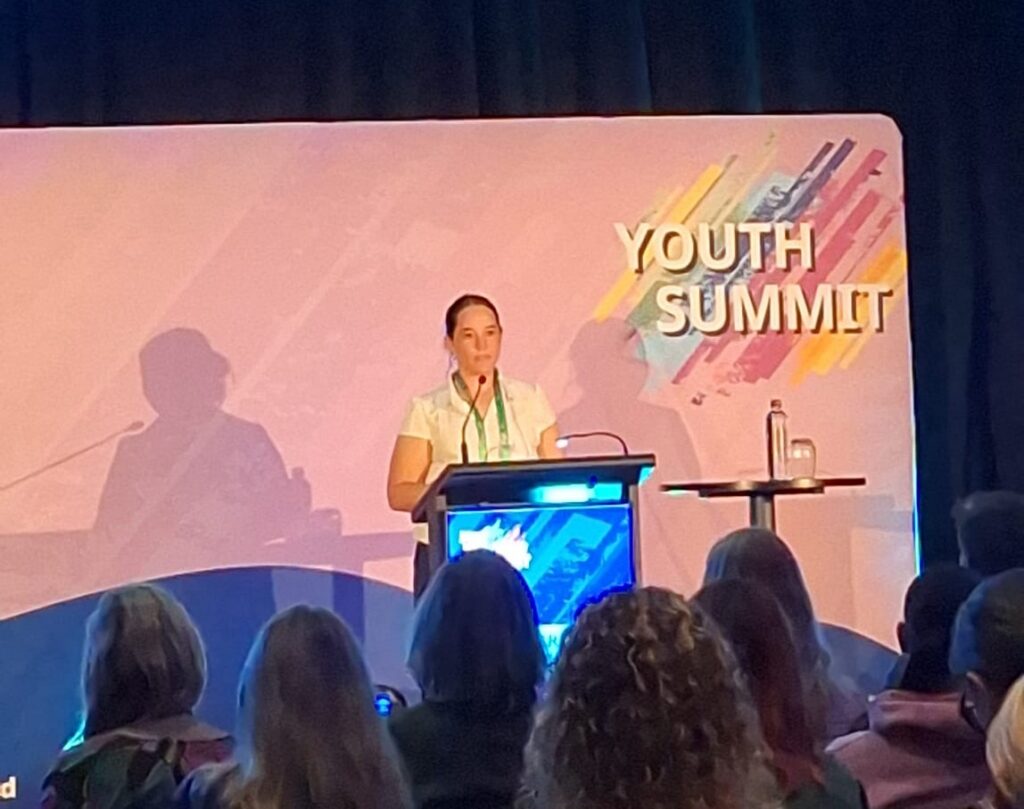
The 16-year-old from Emerald also took part in the Queensland Family and Child Commission’s Youth Summit in Brisbane on 10 April.
Izabella gave a speech at the Youth Summit about her family’s experience of the rural health care system.
Izabella’s mother Kristy is very unwell and being treated as an outpatient of Hervey Bay Hospital, separated from her four children and husband by a seven-hour drive.
Izabella is trying to improve rural healthcare, so that it can better serve families like hers.
“I want to see greater investment in rural healthcare, improved access to specialists, and greater recognition of the impact that health inequity has on young people,” Izabella said.
As well as advocating for better healthcare, Izabella has been active in PCYC’s Emergency Services Cadets since 2022, mentored by Sgt Julia Palmer.
She was one of the first cadets in Emerald and has worked her way up to Unit Leader.
Activities Izabella has participated in at Emergency Services Cadets include first aid, casualty management, search and rescue, swift water theory, road safety, forensics, highway patrol, K9 units, navigation, radio communications, team building and problem solving, as well as attending the Cadet Games for the past two years.
“I have taken my team to the Cadet Games in Townsville twice, placing second both times,” Izabella said.
“I love leading others and all the experiences I have had at Cadets.”
Izabella would like to take what she has learned at Emergency Services Cadets to become a police officer in the future.
Izabella currently goes above and beyond the call of duty to attend school, Emergency Services Cadets, her part time job, and to help her Dad look after the family, all whilst missing her much loved Mum!
Izabella’s father Ben is so proud of his daughter.
“Kristy and I are super proud of Izabella and everything she has achieved and we can’t wait to see what she achieves in the future,” Ben said.
By our Gym+Fitness team at PCYC Goondiwindi
Is sugar really bad for you? Is it addictive? How much is too much? Are there different types of sugar? In this article we aim to answer all your questions and bust all the myths surrounding the great sugar debate!
In a nutshell sugar is simple carbohydrate. Carbohydrates along with Protein and Fat are Macronutrients that provide your body with energy. Our bodies need varying amounts of each macronutrient to function. Sugar comes in many forms – fructose, glucose, sucrose, lactose, and they all have a different effect on the body and brain.
Sugar is sugar, no matter how processed, fancy or popular it is.
– Tara Leong, ‘The Nutrition Guru and the Chef’
Sugar can be found in many natural and processed foods. Dairy products, vegetables, soy products and of course natures natural lolly – fruit. Fruits and vegetables contain many more necessary micronutrients and should be included in a healthy well-balanced diet. Processed sugar is often used as a flavour enhancer and preservative in packaged foods. ie Lollies, soft drinks, cakes and pastries fruit juice and condiments … the list goes on!
Food Standards Australia recommends for an adult of a healthy body mass index to consume no more then 50g or 12 teaspoons of free sugar per day. Free sugar includes all sugars defined as added sugars and the sugar component of honey, fruit juice and fruit juice concentrates. You may find it interesting to track your sugar over the course of a week. Make note of the sugar content on all labels – cereals, pasta sauces, spreads as well as drinks and sugar added to teas and coffees. You might be surprised! A study from the Sugar Nutrition Resource Centre shows that in 2011-12, Australians consumed an average of 60 grams of free sugars per day (equivalent to 14 teaspoons of white sugar). The majority of free sugar intakes comes from added sugars with an average 52 grams (or 12 teaspoons), with 7 grams of free sugars coming from honey and fruit juice. One 375ml can of soft drink contains over 44grams of sugar!
Sugar addiction has been the subject of many books, diets, and studies over the last few years, but is it really addictive? One study done on animals showed similar effects of bingeing and withdrawal behaviour similar to drug abuse. (Colantuoni et al., 2001/2002) The reviewed evidence supports the theory that in certain people, often obese and/or bulimic, sugar can lead to behaviour and neurochemical changes that resemble the effects of a substance of abuse. In a well-balanced diet, there is no evidence of sugar dependence. (Neuroscience and biobehavioral reviews)
Does sugar cause disease? Well not directly…it’s the amount of sugar consumed that has an adverse effect on the body. Excess sugar can lead to several health complications – obesity, metabolic syndrome and inflammatory diseases just to name a few. Different types of sugars have different effects on the body and brain.
“The body does not respond the same way to fructose in fruit as to added fructose. As an added sugar, fructose is particularly implicated in metabolic syndrome, hypertension, insulin resistance, lipogenesis, diabetes and associated retinopathy, kidney disease and inflammation.” (Impact of sugar on the body, brain and behaviour. Frontiers in bioscience)
The answer to the BIG question is NO and YES.
NO – If we are consuming the right amount of sugar for our daily intake from natural sugars with the occasional treat, we can sustain a health body and mind.
YES – If consuming excessive amounts of sugars above the recommended daily intake from processed and added sugar foods and drinks, we can develop poor health and disease.
All in all, moderation is key when it comes to sugar.
– Tammy Bell, PCYC Goondiwindi